In the world of accessibility, mathematical studies have been a long standing challenge. For students, online math instruction and assessment can pose barriers. More specifically, there is not a sufficient, two-way method for getting math and science information, like charts, graphs, tables, or code for equations, to and from a refreshable braille display, which poses a challenge for online assessment. Thanks to innovation, research, and advancements in technology, some of these challenges are being addressed. This session will discuss the work NWEA is leading, in collaboration with the Perkins Access digital accessibility consulting team, to make middle school mathematics assessments more accessible for students with visual disabilities using Artificial Intelligence (AI) technology. NWEA accessibility research manager, Dr. Elizabeth Barker, was awarded a generous AI for Accessibility grant from Microsoft to help further these efforts.
Presenters
- Geoff Freed, Director of Perkins Access Consulting, Perkins Access
- Elizabeth RG Barker, Ph.D., Accessibility Research Manager, NWEA
- Dr. Sarah McManus, Digital Learning Director for the Education Services, Governor Morehead School for the Blind
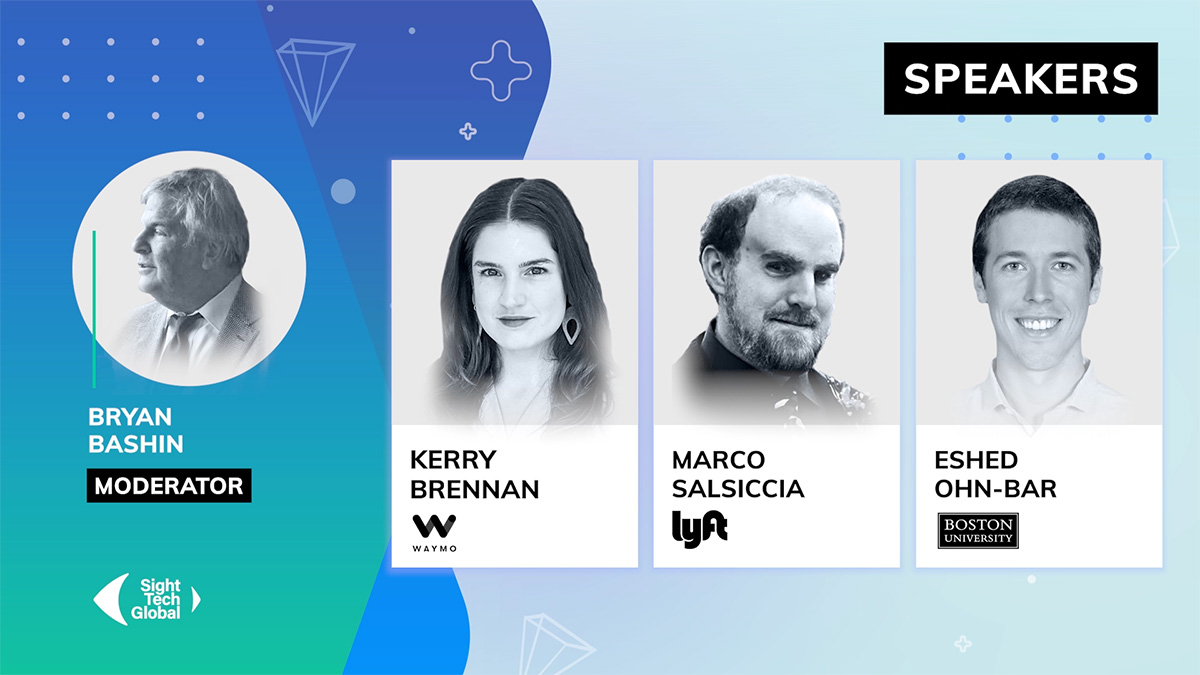
Summoning a ride from a smart phone is a dream come true for many, but when you have difficulty finding that ride, even when it’s a few feet away, the experience can be a nightmare, not to mention dangerous. How are ride-share and autonomous taxi companies working to make those last few feet from rider-to-car safer and better for blind and low vision riders?
Nearly three quarters of mobile phone users in the world use phones built on Google’s Android operating system, not Apple’s iOS on the iPhone. For people who are blind or have low vision the key app is Google’s Lookout, which draws on the vast resources of Google’s AI infrastructure, including its computer vision database and Google maps. How is Google approaching the huge accessibility opportunity Lookout represents?
Accessibility awareness is on the rise, but even teams with the best of intentions can flounder when it comes to finding the right approaches. One key is to work closely with the appropriate communities of users to get feedback and understand needs. The result is not trade-offs but a better product for everyone. In this session, we’ll hear from experts on the frontline of accessibility in product development.
Inventors have long been inspired to apply their genius to helping blind people. Think of innovators like Mike Shebanek (Voiceover, Apple) or Jim Fruchterman (Bookshare, Benetech), to name just two. Today, innovators have a nearly miraculous array of affordable technologies to work with, including LIDAR, computer vision, high speed data networks, and more. As a result, innovation is moving ahead at a dizzying pace. In this session, we will talk to three three product innovators on the forefront of turning those core technologies into remarkable new tools for people who are blind or visually impaired.
As homes become increasingly more technology-driven, inputs from multiple sources—teachable AI, multimodal understanding, sensors, computer vision, and more—will create a truly ambient, surround experience. Already, 1 in every 5 Alexa smart home interactions is initiated by Alexa without any spoken command. As Alexa develops an understanding of us and our home well enough to predict our needs and act on our behalf in meaningful ways, what are the implications for accessibility?
Thanks to mobile phones, GPS, and navigation apps, people who are blind or visually impaired can get around outdoors independently. Navigating indoors is another matter.
For starters, GPS is often not available indoors. Then there are the challenges of knowing where the door is, finding the stairs, or avoiding the couch someone moved. Combining on-phone and in-cloud technologies like inertial navigation, audio AR, LiDAR and computer vision may be the foundation for a solution, if product developers can map indoor spaces, provide indoor positioning and deliver an accessible user interface.
Today, instant access to the written word in braille is much less available to someone who is blind than the printed word is for someone who is sighted. Tools such as single line refreshable braille displays have been available for years, but a single line at a time gives the user a very limited reading experience. This limitation is especially felt when users are reading lengthy documents or when they encounter content such as charts and graphs in a textbook. The American Printing House for the Blind (APH), and HumanWare have teamed to develop a device capable of rendering multiple lines of braille and tactile graphics on the same tactile surface. Currently referred to as the Dynamic Tactile Device (DTD), this tool aims to provide blind users with a multi-line book reader, tactile graphics viewer and so much more. (This session will be followed by a live breakout Q&A session with Greg Stilson, head of APH’s Global Technology Innovation team, and HumanWare’s Andrew Flattres, Braille Product Manager.)